AirTag vs QR Code Tag: Which Is Better for Recovering Lost Items?

Kevin Hall
Apr 11th, 2026
·9min read
Apr 11th, 2026
·9min read
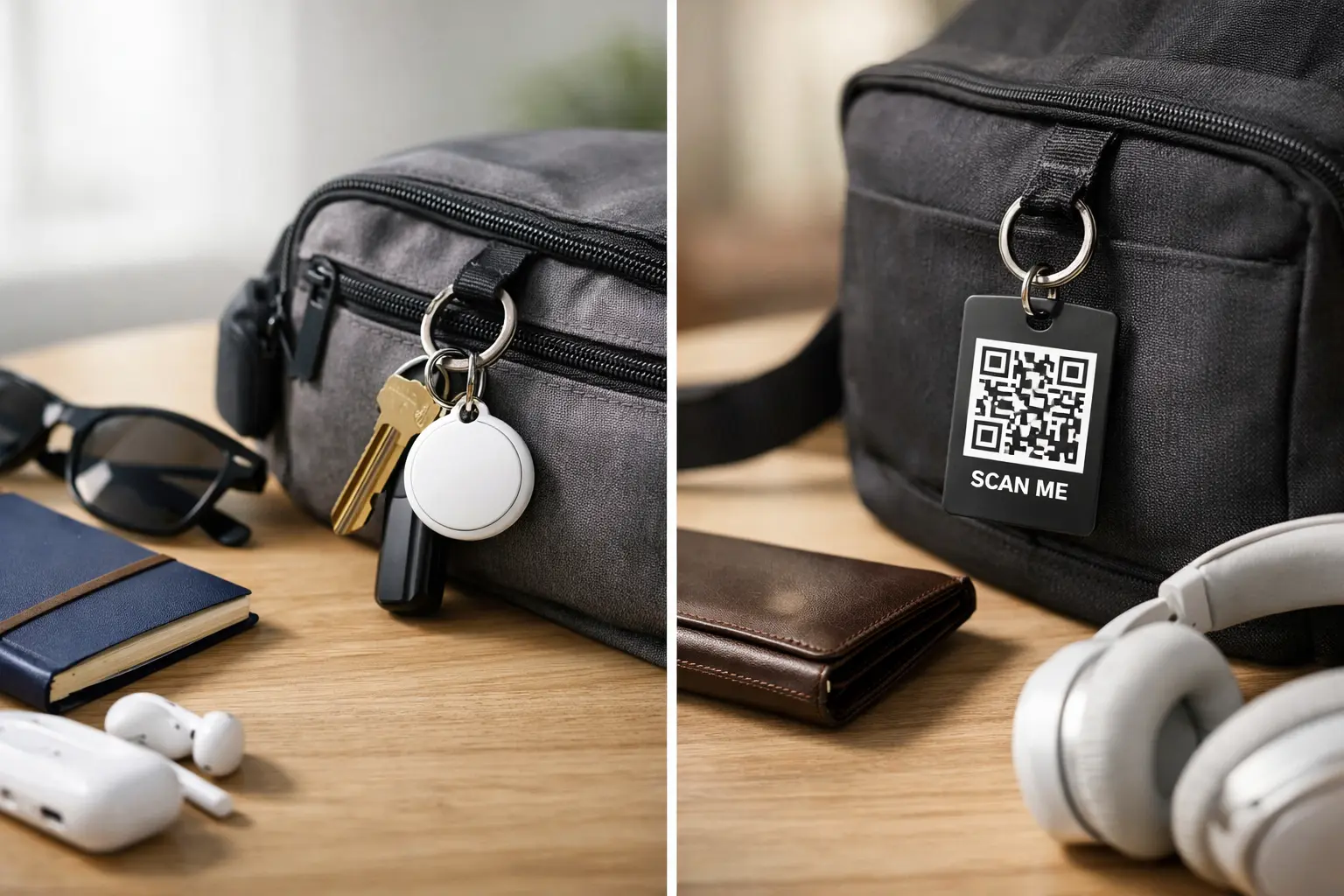
If you want the short answer, this is it:
That is because AirTag and QR code tags solve different parts of the same problem.
An AirTag helps you work out where the item is. A QR code tag helps the person who found it work out how to reach you.
Those are not the same thing.
If you are comparing the two because you want the best tag for recovering lost items, the right choice depends less on the label itself and more on how your items usually go missing.
This guide explains how each option works, where each one helps most, the privacy and cost tradeoffs, and the verdict for different kinds of lost property.
An AirTag is primarily a location tool.
It uses Apple’s Find My network to help the owner see where the tagged item was last detected. That is useful when the item is still moving, has fallen somewhere hard to search, or was left in a vehicle, train, terminal, taxi, park, or other space where no one has contacted you yet.
A QR code tag is primarily a return tool.
It gives a finder something they can scan, which usually opens a contact page, profile, or report flow that helps them tell you they found the item. That is useful when the item is already in someone else’s hand or sitting at a reception desk, venue office, school, gym, or lost-property counter.
So the real question is not “Which tag is better?”
It is “Do I need help locating the item, or do I need help getting contacted once someone finds it?”
AirTag is strongest when the item does not stay in one obvious place.
Typical AirTag recovery flow:
That means AirTag is especially useful for:
AirTag is less useful when:
In other words, AirTag is best when the main problem is finding the item again, not just labeling it.
A QR code tag is strongest when an honest finder is the most likely path to recovery.
Typical QR code recovery flow:
That makes QR code tags especially useful for:
QR code tags are less useful when:
QR tags do not track movement. They depend on the finder taking action.
That is the tradeoff: they are simple and low-friction, but they only work once a helpful person interacts with the tag.
| Question | AirTag | QR code tag |
|---|---|---|
| Helps you see where the item may be | Strong | Weak |
| Helps a finder contact you quickly | Limited | Strong |
| Needs a battery | Yes | No |
| Usually costs more | Yes | No |
| Works well for school and venue hand-ins | Mixed | Strong |
| Works well when the item keeps moving | Strong | Weak |
| Useful without a branded service or app page | Mixed | Mixed |
| Best for low-cost bulk labeling | Weak | Strong |
If you only read one section, read the next one.
For keys:
For wallets:
For backpacks and travel bags:
For school gear, sports gear, and everyday belongings:
For laptops, tablets, instrument cases, and higher-value kit:
For coats, lunch boxes, water bottles, and lower-value items:
People often compare these tags on convenience, but privacy matters just as much.
With AirTag:
With QR code tags:
A good rule is:
AirTag usually costs more per item and needs ongoing battery attention.
That is fine if you are tagging a few high-value belongings. It is less attractive if you want to label every school item, jacket, water bottle, charger pouch, or set of sports gear in the house.
QR code tags usually scale better because they are cheaper and simpler:
So if your goal is “I want all my ordinary belongings to have some path back to me,” QR code tags are often the more practical baseline.
If your goal is “I need the best chance of recovering a few expensive items if they move around after I lose them,” AirTag often gives more value.
Neither tag replaces good recovery habits.
AirTag does not:
QR code tags do not:
Whichever tag you use, you still need a good first-hour response and enough private details to prove the item is yours later. If the item is already missing, start with What to Do in the First Hour After Losing Something Important. If someone says they found it, use How to Prove an Item Is Yours When Someone Finds It before sharing sensitive information.
If you only want one rule, use this:
That is usually the most practical answer.
Why?
Because most ordinary lost property is recovered through people and desks, not through tracking networks.
But the items that hurt most to lose are often the items that keep moving.
A school jumper, lunch box, or water bottle usually needs a clear label.
A bag of tech, a suitcase, or a key set may benefit much more from location clues.
If you want the better single tool for locating a moving item, AirTag wins.
If you want the better single tool for helping an honest finder return everyday lost property, QR code tag wins.
If you want the best overall recovery setup, especially for valuable bags, keys, wallets, or equipment, the strongest answer is often not “AirTag or QR code tag.” It is “AirTag and QR code tag together.”
Use AirTag when finding the item again is the hard part.
Use QR code when contacting you quickly is the hard part.
Use both when you do not want recovery to depend on only one path.
Is AirTag better than a QR code tag for keys?
Often yes for location, especially if keys are dropped while travelling or misplaced at home. But a QR code can still help if the keys are handed to staff, security, or a finder who wants to contact you directly.
Is a QR code tag better for school items?
Usually yes. School and sports items are often recovered through teachers, front offices, reception desks, and other parents. A visible return route usually matters more than live location.
Should I put my phone number directly on a QR tag?
Usually only if you are comfortable sharing it publicly. A dedicated recovery page or separate email is often safer.
Can I use both on the same item?
Yes. For many high-value or frequently travelled items, that is the best setup. One helps locate the item. The other helps the finder reach you.
Do I still need to make a lost-item report if the item has a tag?
Yes. A tag improves your chances, but it does not replace reporting the loss clearly and quickly. If the item is already missing and could have surfaced beyond one obvious venue or operator, create a clear lost-item report while the details are still fresh.
Whether you've lost a cherished item or found something that belongs to someone else, posting an ad on lostandfound.io can help reunite items with their owners. It's free and easy to do.
Post a FREE ad